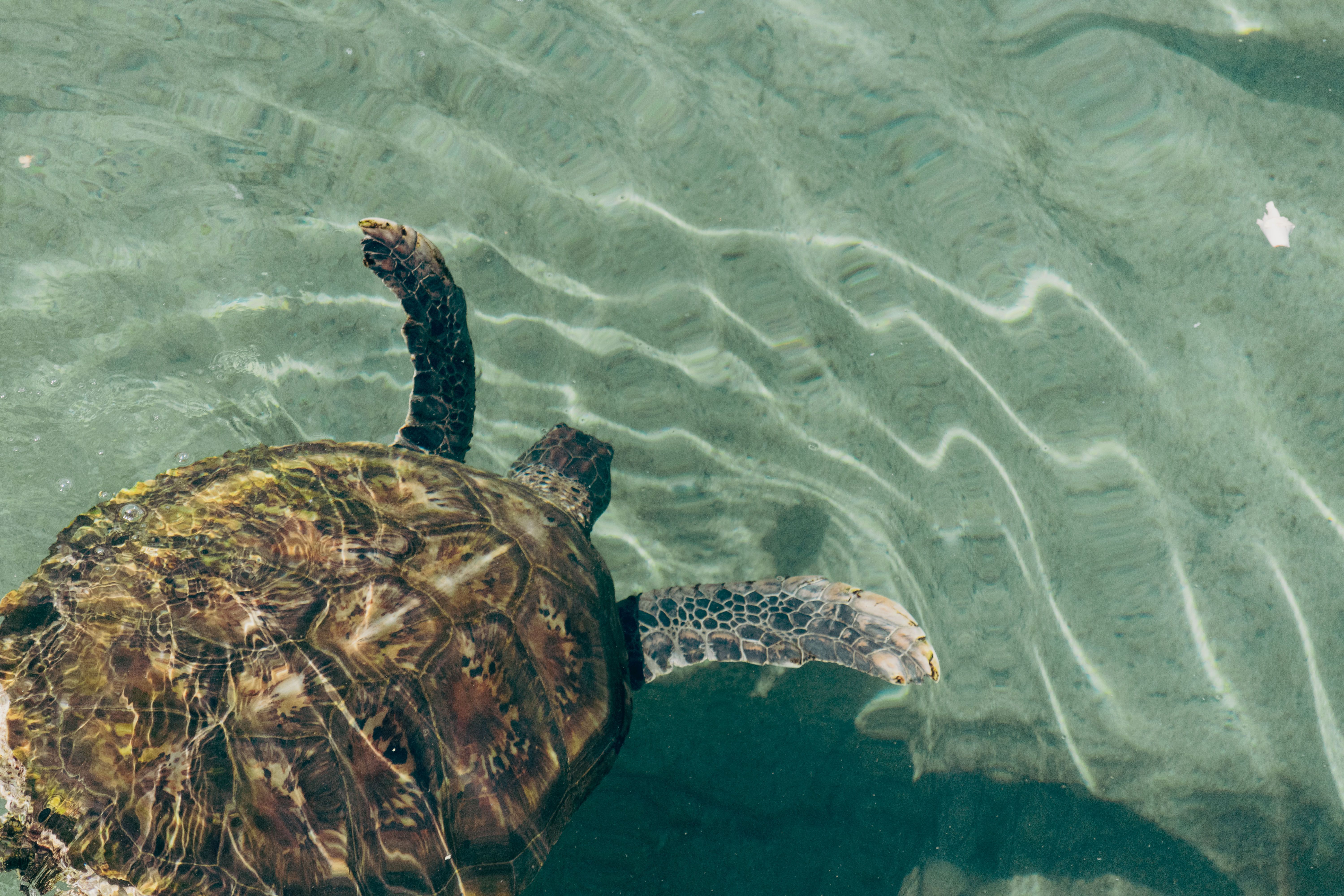
Green sea turtle (Chelonia mydas), Moorea, French Polynesia. Photo by Charles J. Sharp (CC BY-SA 4.0)

Green Turtle Recovery: A Major Conservation Success in Advance of CMS COP15

Four decades after being classified as ‘Endangered,’ the green turtle (Chelonia mydas) was recently reclassified by the International Union for Conservation of Nature (IUCN) to ‘Least Concern’. This marked the first time an endangered marine turtle was reclassified to a non-threatened category.
Read more
Green turtles at Raine Island, Australia © Great Barrier Reef Foundation

Blue Corridors for Turtles – Funding Opportunity and Call for Data to Identify Important Marine Turtle Areas (IMTAs)

Blue Corridors for Turtles (BC4T) is a global initiative bringing together research institutions, non-profits, corporations, government agencies and local communities to conserve marine turtle

Read more
Sea turtle carapaces and skulls used as decoration on tribal house © Adela Hemelikova

Sea Turtle Protection Starts with Understanding More About the People who Take and Use Turtles

by Adela Hemelikova ([email protected]), Petr Chajma, Teuku Reza Ferasyi, Awaluddin, Nur Fadli, Widya Sari, Christine Madden, Kimberly Riskas, and Jiri Vojar
Read more
Shark underwater at Cabo San Lucas, B.C.S., Mexico
Shark underwater at Cabo San Lucas, B.C.S., Mexico / Photo by Elianne Dipp

High Seas Treaty: A New Era for Migratory Species and Ocean Governance

The Agreement under the United Nations Convention on the Law of the Sea (UNCLOS) on the Conservation and Sustainable Use of Marine Biological Diversity of Areas Beyond National Jurisdiction (BBNJ Agreement) has reached the threshold for entry into force. This historic milestone marks the beginning of a new era for the conservation and sustainable use of marine biodiversity in the high seas—an area covering two-thirds of the world’s ocean.
Read more
Close up of a Jaguar drinking water on a river bank, North Pantanal, Brazil. Photo by Giedrius Stakauskas. Cover of the Global Wetland Outlook 2025 Report

Migratory Species and Wetlands: Insights from the Global Wetland Outlook 2025

Bonn, 21 July 2025 — Wetlands, which sustain life across the planet, are disappearing faster than any other ecosystem.

Read more
title

Investing in Biodiversity: Unlocking Greater Returns

The Liaison Group of Biodiversity-related Conventions (BLG), a long-standing network uniting the executive heads of the eight biodiversity-related conventions, met on 21 February 2025 at FAO Headquarters in Rome ahead of the resumed sessions of the United Nations Biodiversity Conference (CBD COP16). The group reaffirmed their collective support to the conservation and sustainable use of biodiversity and the Kunming-Montreal Global Biodiversity Framework (KMGBF). 
Read more
Synth85, CC BY-SA 4.0 https://creativecommons.org/licenses/by-sa/4.0, via Wikimedia Commons

Consuming Sea Turtle Meat: Health Risks and Conservation Impacts

In a recent tragic incident in the Philippines, three people lost their lives and over 30 others were hospitalized after consuming a stew made with marine turtle meat. This tragic event is not an isolated incident, with the consumption of sea turtle meat leading to over 2400 known cases of illness and 420 fatalities worldwide since 1900.
Read more
Hawksbill turtle © blueorangestudio/Canva.com

Kuwait Joins International Efforts to Protect Marine Turtles

1 September 2024 - In a significant step to increase environmental conservation, the State of Kuwait has officially become a Signatory to the Memorandum of Understanding on the Con

Read more

Internship Opportunities at the CMS Aquatic Species Team

Are you a university student or a recent graduate?  Are you interested in aquatic migratory species?  Are you interested in the work of a multilateral environmental agreement of the United Nations?  If your answer is yes, consider applying for an internship at the CMS Secretariat! Check out the details in the Job Opening on the UN Careers page.  
Read more
title

COP14 - Ce que l'on peut attendre des espèces aquatiques migratrices ?

Parmi les espèces migratrices répertoriées dans la Convention sur les espèces migratrices, 64 sont des mammifères aquatiques, 54 des poissons et 9 des reptiles, couvrant de nombreuses espèces diverses telles que les baleines, les requins et les tortues. Leurs aires de migration comprennent les rivières, les estuaires, les plages, les prairies marines, les récifs coralliens, les zones côtières, la haute mer, les fosses profondes et les monts sous-marins, pour n'en citer que quelques-uns. On les trouve dans toutes les zones climatiques, dans tous les océans et dans de nombreux systèmes d'eaux intérieures. Les menaces qui pèsent sur eux sont multiples et comprennent la surexploitation, la perte et la dégradation de l'habitat, la pollution et le changement climatique.
Read more