Green Turtle Recovery: A Major Conservation Success in Advance of CMS COP15
Highlighting Importance of Sustained International Collaboration for Migratory Species Conservation
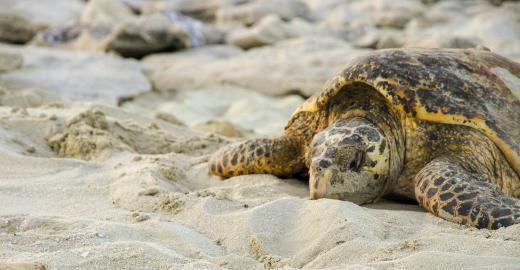
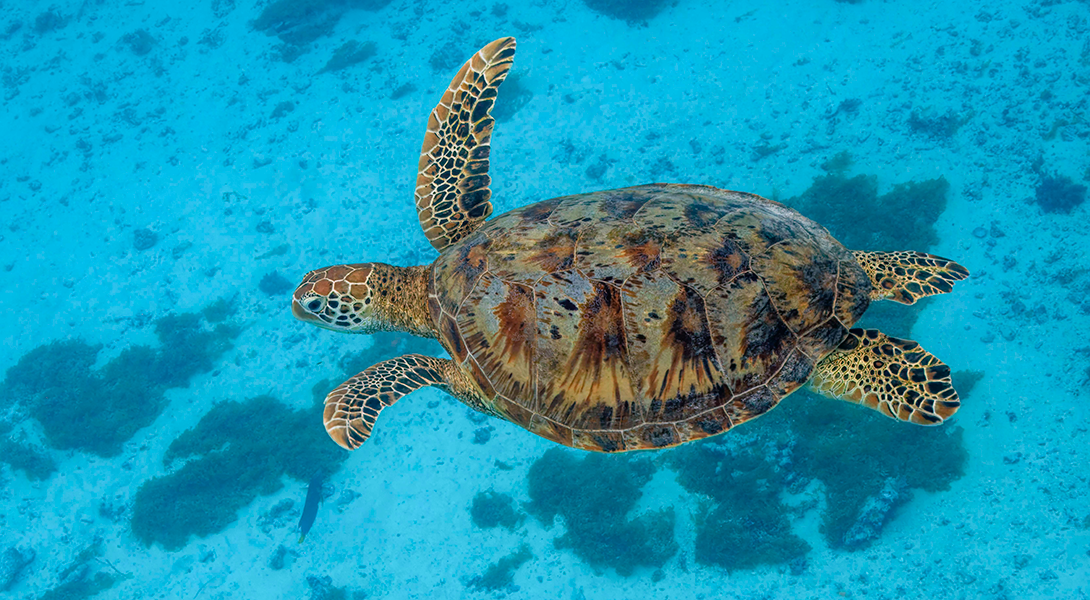
18 February 2026 – Four decades after being classified as ‘Endangered,’ the green turtle (Chelonia mydas) was recently reclassified by the International Union for Conservation of Nature (IUCN) to ‘Least Concern’. This marked the first time an endangered marine turtle was reclassified to a non-threatened category.
This notable achievement in conservation underscores the importance of sustained international cooperation, just as the international community prepares for the 15th Meeting of the Conference of the Parties to the Convention on Migratory Species (CMS COP15) in Brazil. The primary objective of this UN wildlife conservation meeting is to advance international cooperation to enhance the conservation status of migratory species and their habitats.
Why Green Turtles Matter
The green turtle, named for the greenish fat beneath its shell, is a highly migratory species that can live up to over 80 years and grow over 300 Kg. Green turtles play a vital ecological role in maintaining healthy seagrass beds, which are essential for supporting diverse marine life. By grazing on seagrass, they help keep these underwater meadows productive and resilient, enhancing their ability to sequester carbon from the atmosphere. This natural carbon storage contributes to mitigating climate change, making green turtles not only important for marine biodiversity but also for global environmental health.
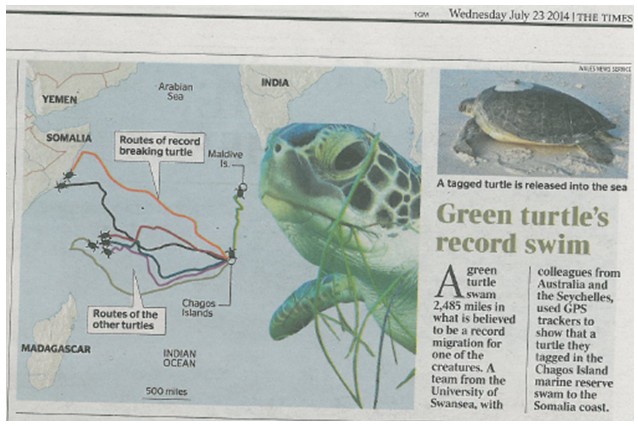 |
Green turtles undertake long migrations spanning decades and crossing the high seas and many national jurisdictions to forage and eventually return to their natal beaches to nest. In 2014, researchers at Swansea University tracking green turtles by satellite recorded an individual turtle traveling 3979 km, from the Chagos Islands in the Indian Ocean, to the coast of Somalia in east Africa.
Drivers of the decline of green turtle populations included direct take of turtles for meat, shells, and eggs; incidental capture (bycatch); plastic pollution; and habitat degradation linked to tourism, mining activities and climate change, ultimately resulting in their previous IUCN status of ‘Endangered’. Concerted efforts to address these threats at local, national and international levels have led to stopping and reversing its decline.
But while the conservation status of green turtles has globally improved, the situation is still not uniform across regional subpopulations. The Central South Pacific population is still classified as ‘Endangered’ (2023) on the IUCN Red List of Threatened Species, and the populations of East Pacific (2023) and North Indian Ocean (2019) are classified as ‘Vulnerable’. The populations of Central West Pacific (2025) and the Mediterranean (2024) are also classified as ‘Near Threatened’ by the IUCN.
Also, despite the global population recovery and increasing trend, the green turtle remains far below its historic abundance and continues to be subject to multiple pressures across its range and all life stages.
Ongoing and consistent conservation efforts are essential to maintain the improved status of the green turtle which is one of seven species of marine turtles. The green turtle’s comeback can be an inspiration for conservation initiatives focusing on the other six marine turtle species, all of which continue to be classified between Vulnerable and Critically Endangered on the IUCN Red List.
Key Role of International Conservation Efforts
Because marine turtles migrate across vast areas, successful conservation relies on strong international cooperation. The Convention on the Conservation of Migratory Species of Wild Animals (CMS), a legally-binding treaty of the United Nations, and its dedicated regional agreements play a pivotal role in focusing international cooperation to conserve and restore populations of these shared migratory species.
The IOSEA Marine Turtle Memorandum of Understanding (MOU) provides detailed guidance and a collaborative framework for Signatory States across the Indian Ocean and South-East Asia to implement actions such as protecting nesting and foraging habitats, reducing direct take and bycatch, strengthening legal protections of the species, and enhancing research and monitoring efforts.
Similarly, the Atlantic Turtle MOU supports Signatory States along the Atlantic coast of Africa with its Conservation and Management Plan, most recently updated in 2023, which outlines practical measures for habitat conservation, mitigation of threats such as fisheries bycatch and illegal take, and the promotion of public awareness and community engagement in marine turtle conservation. The 2023 Plan places added emphasis on adaptive management, community-based conservation initiatives, and the integration of new scientific research and monitoring techniques to ensure the effectiveness of protection measures.
For the green turtle, being listed under CMS Appendices I (aimed at species that are endangered) and II (aimed at species that would benefit from international cooperation) since 1979 has ensured its status as a priority for coordinated, cross-border conservation, driving collaborative efforts that have been instrumental in its remarkable recovery.
In addition to the two MOUs, CMS promotes targeted action through Single Species Action Plans (SSAPs) such as the Single Species Action Plan for the Loggerhead Turtle (Caretta caretta) in the South Pacific Ocean and the Single Species Action Plan for the Hawksbill Turtle (Eretmochelys imbricata) in South-East Asia and the Western Pacific Ocean Region. These species-specific initiatives serve as comprehensive roadmaps detailing priority conservation activities, setting measurable targets, and fostering partnerships across range states to address the unique needs of each turtle species.
The CMS COP15, scheduled to take place from 23 to 29 March 2026 in Campo Grande, Brazil, will bring together governments, scientists, conservation organizations, indigenous peoples and local communities, and other stakeholders to address the growing pressures on migratory species and their habitats. COP15 is expected to adopt numerous new mandates to strengthen actions for the conservation of migratory species, including marine turtles.
CMS Parties will review updated scientific assessments on threats, such as climate change impacts on nesting beaches, marine pollution, and fisheries bycatch, and considering new measures to mitigate these pressures. Key actions that COP15 will consider include endorsing adaptive beach management practices, promoting the designation of Important Marine Turtle Areas, and strengthening regional cooperation under instruments like the IOSEA Marine Turtle MOU. The international meeting will also consider aligning marine turtle initiatives with the Samarkand Strategic Plan for Migratory Species (2024–2032), to ensure that conservation targets are integrated into global actions and frameworks. These decisions aim to secure resilient habitats and reduce mortality risks, providing a critical boost to the long-term recovery of green turtles and other marine species.