
The Turtle in the Plastic Bag
A Rescue in the Arabian Sea
In April 2016, about 145 nautical miles off Karachi, a tuna gillnet crew spotted what appeared to be a floating polypropylene sack drifting across the Arabian Sea.
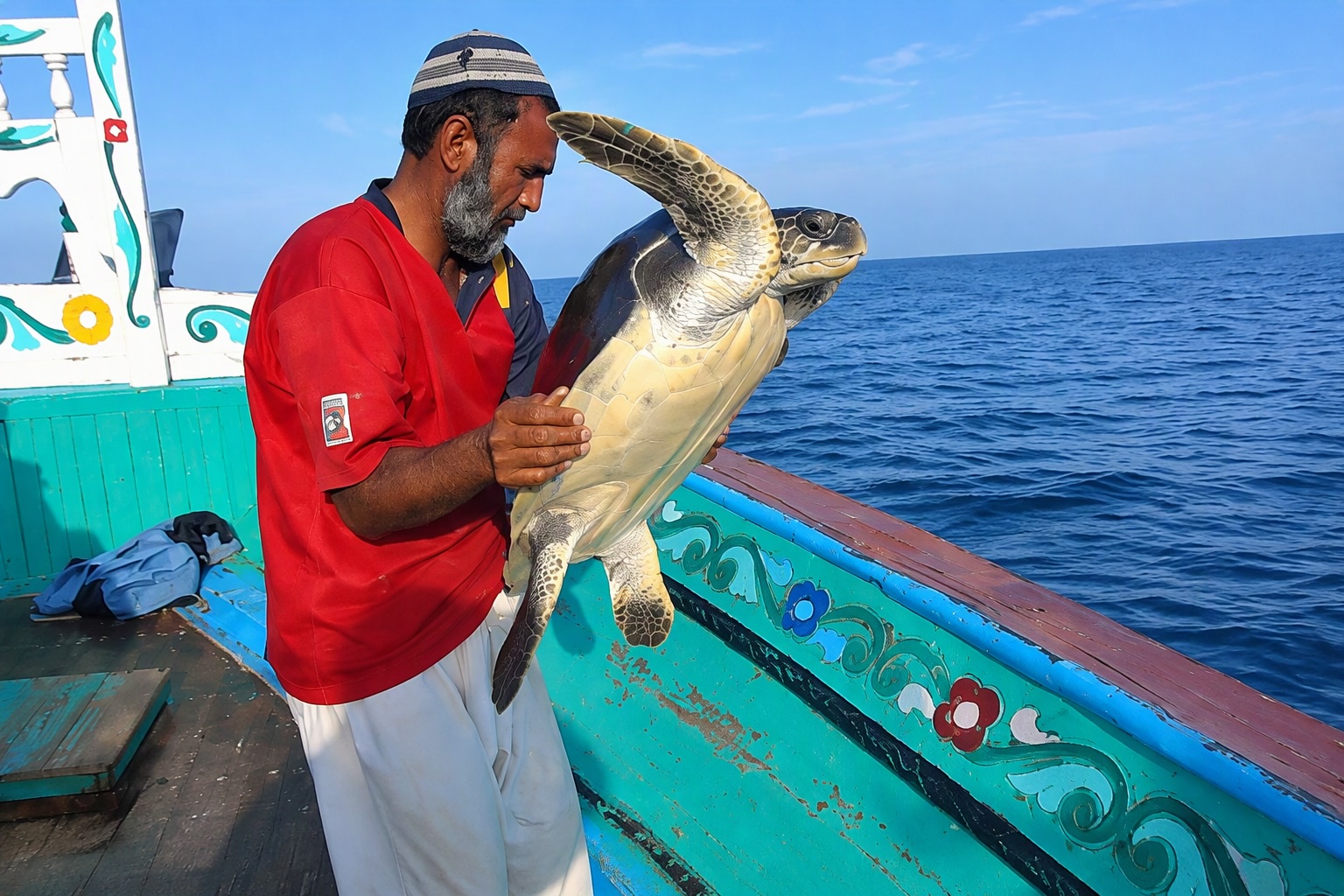
Most people would have seen only another piece of marine litter. But Amir Rahim, who had joined WWF-Pakistan's crew-based observer programme five months earlier, decided to take a closer look. Inside the sack was an olive ridley turtle, struggling to free itself. Amir had released many turtles from fishing nets, he said later, but he had never seen one trapped in a plastic bag.
The turtle was dragging the sack behind it and could not escape. Amir jumped into the water, but the turtle was so tightly trapped that it could not be freed at sea. Working together, the crew carefully lifted the turtle aboard their vessel, cut away the plastic, checked it for injuries, and released it safely back into the ocean unharmed.
A Hidden Threat Far from Shore
Amir’s rescue highlights a growing threat to sea turtles: marine plastic pollution. This olive ridley was caught not in fishing gear but in discarded plastic, possibly dumped from a passing vessel or run off by the land source waste channels. Plastic waste can travel vast distances and become a deadly hazard from marine life, even far offshore.
That this turtle survived was not luck alone. It was found by someone trained to notice and act for its safe release.
A Programme that Empowers Fishers
Rather than placing outside scientists aboard fishing vessels, WWF-Pakistan’s crew-based observer programme trained skippers and crew members to collect data, identify vulnerable marine species and safely release animal caught accidently at sea. Amir was one of 100 trained fishers participating in WWF-Pakistan's crew-based observer programme. He had been participating in the programme since November 2015 when he encountered the turtle in April 2016. These fisher-observers act as first responders, often operating in remote offshore waters where no conservationists are present.
The programme began in 2012 with just four skipper-observers and grew to 85 by 2016. Over its lifetime, more than 100 tuna gillnet fishers, 89 of them skippers, were trained in species identification, data collection and reporting, and safe handling and release techniques for the Endangered, Threatened and Protected (ETP) species including turtles, whale sharks, mobulids, sunfish, seabirds, sea snakes, and marine mammals.
Changing Practices at Sea
What started as an experiment grew into one of the most extensive fisher-led monitoring programmes in the region. Between 2012 and 2019, the observer network monitored 32,186 fishing operations aboard 142 vessels and recorded 867 turtle capture events involving 955 turtles. Of those 867 events, 834 (96 per cent), ended with the turtles being released alive.
The programme did more than collect data. It helped transform fishing practices. In its first year, nearly one-third of turtles encountered were recorded as dead at release. As crews improved their handling techniques, mortality at release fell sharply, and none were recorded in 2016, 2017 or 2019.
The rescue videos submitted by fishers played a crucial role in this change. They allowed WWF-Pakistan to review how animals were being handled and to develop improved guidance for safe release. Fisher-observers learned from one another, sharing techniques and demonstrating that conservation and fishing can go hand in hand.
The footage of Amir's rescue became one of the best-known videos produced through WWF-Pakistan's crew-based observer programme, illustrating the important role trained fishers can play in marine conservation.
From One Turtle to a Bigger Story
Amir’s rescue was not a one-off. Across Pakistan's tuna fleet, trained fisher-observers have released hundreds of sea turtles, documented whale sightings, helped rescue whale sharks and mobulids, and contributed information that is now used in national and international fisheries management, including Indian Ocean Tuna Commission (IOTC). Their work demonstrates that fishers are not only users of marine resources. With the right knowledge and support, they can become some of the ocean's most effective guardians.
For Amir Rahim, that commitment began with a simple decision to investigate a floating piece of plastic. For one olive ridley turtle, it made all the difference.
Watch the video below to see Amir Rahim and his crew rescue the olive ridley turtle in action:
By Shoaib Abdul Razzaque, WWF-Pakistan
As we celebrate 25 years of the IOSEA Marine Turtle MOU, we showcase some of the people, initiatives and communities that have contributed to marine turtle conservation across the region. Visit our Story Map to discover their stories.