
Following the Evidence: Science as the Foundation for Conservation Action
Understanding how sea turtles move between habitats and across national borders is essential for determining how and where they need to be protected. For 25 years, the IOSEA Marine Turtle MOU has provided a framework for countries to work together to conserve sea turtles and their habitats, guided by the best available scientific evidence.
In a region as vast and diverse as the Indian Ocean and South-East Asia, science provides a common basis for conservation. Research and monitoring can reveal connections that national borders obscure, long-term datasets can show where populations are recovering or declining, genetic analyses and flipper and satellite tags can reveal linkages between feeding and nesting turtle populations, and this evidence can help governments decide where conservation actions are most needed.
Marine turtles also face a range of pressures that require targeted interventions. Reducing fisheries bycatch depends on understanding where and how turtles interact with fishing activities. Climate change can affect nesting conditions, hatchling sex ratios and nesting seasons, while plastic pollution poses risks through ingestion and entanglement. Addressing these and other challenges requires scientific knowledge to identify the most effective conservation measures.
One of the strengths of the MOU is the structure it has created to connect scientific knowledge with conservation decisions. At the heart of this link is its Advisory Committee.
The Advisory Committee: Where Science Meets Decision-Making
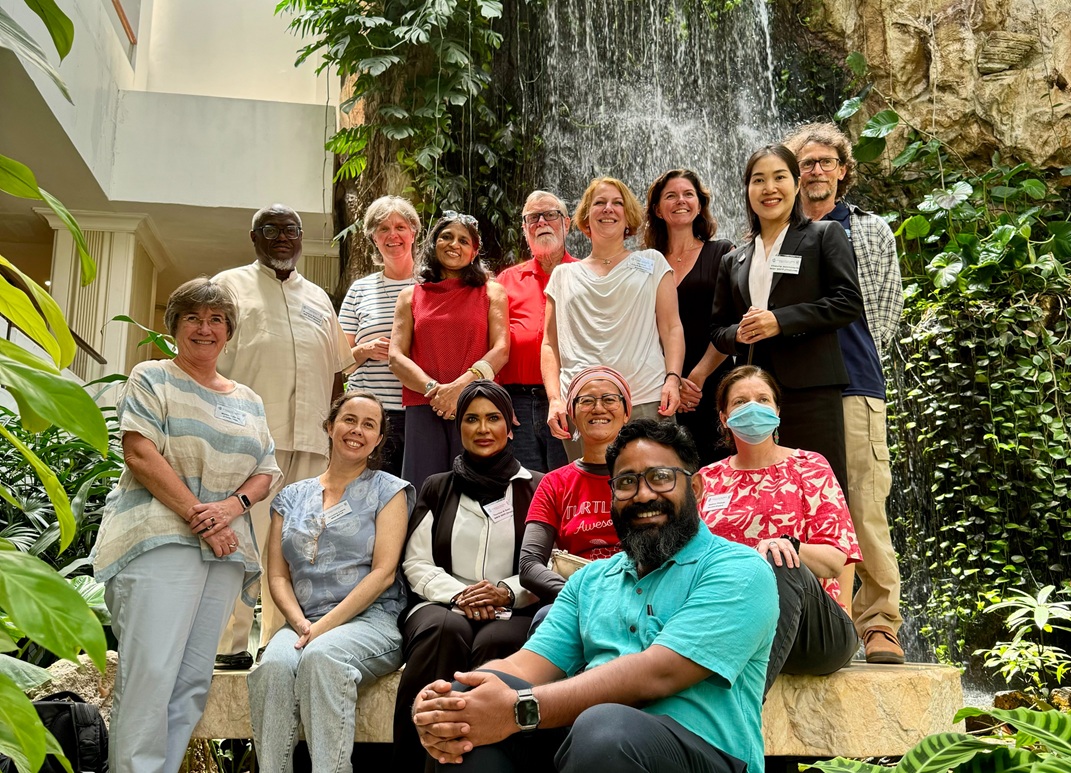
The Advisory Committee (AC) is central to the MOU’s science-based approach. Its role is to provide scientific, technical and legal advice to the Signatory States and to support them in implementing their conservation commitments. While nominated and chosen by the Signatory States, the AC members serve as volunteers in their individual capacities rather than as representatives of governments or organizations. They bring together expertise ranging from marine turtle biology and fisheries technology to marine resource management, coastal development, coastal ecology, socioeconomics and law, as well as conservation and sustainability.
The Committee works across a range of conservation issues. It can, for example, evaluate conservation and management programmes, assess measures to reduce incidental capture and mortality of marine turtles in fisheries, advise on conservation actions needed to implement the Conservation and Management Plan, assess the conservation status of sea turtle populations and species, identify research and monitoring needs, and provide capacity building. In all this, the AC’s expertise allows it to provide a regional, population-wide perspective, rather than being focused only on the turtles present in any country’s national waters.
For specific issues requiring more focused attention, the AC can bring together specialist expertise through dedicated working groups. At the moment, these include two working groups convened together with the Scientific Council of the Convention on Migratory Species (CMS), focusing on turtle bycatch and nesting beach management. The AC also convenes or supports other working groups addressing priorities identified by the Signatory States, including one on the IOSEA Network of Sites of Importance for Marine Turtles.
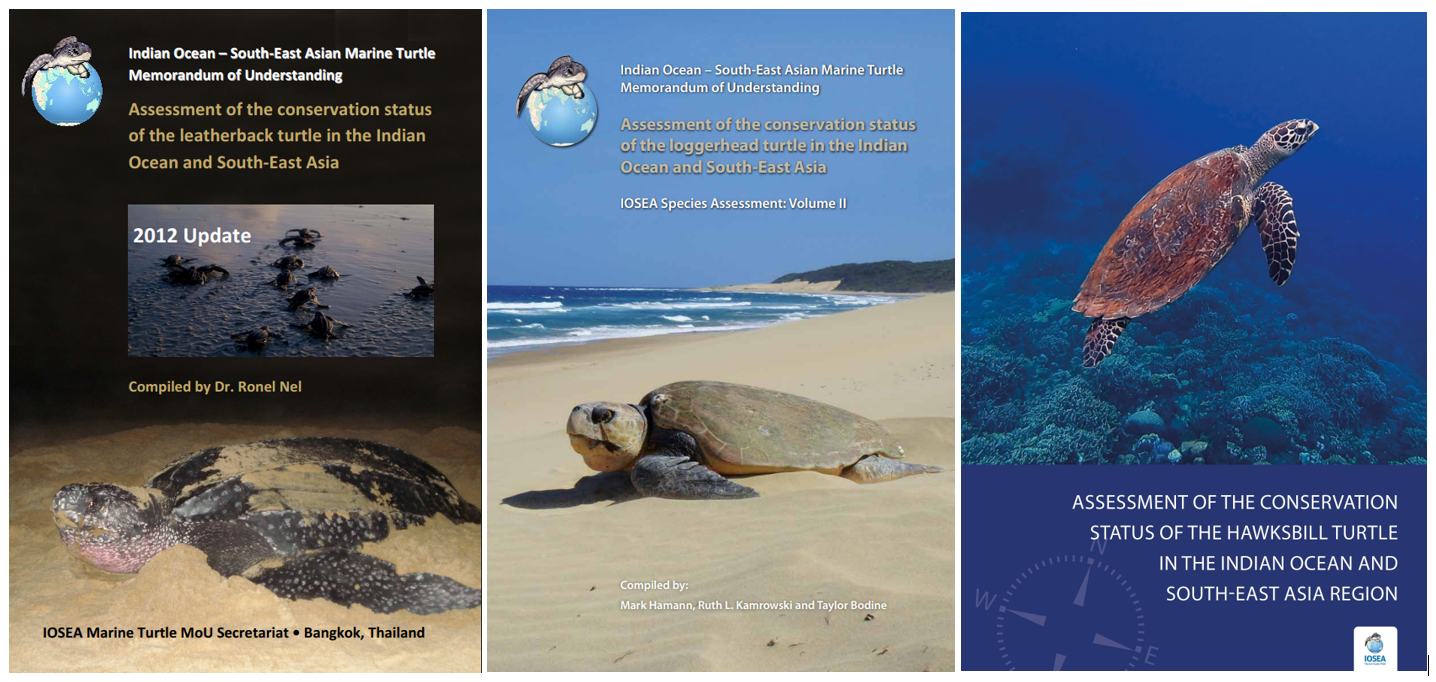
Species-specific status assessments developed under AC leadership can help identify conservation priorities and areas requiring further research (see here the assessments for leatherback, loggerhead and hawksbill turtles).
Often, AC members will also take the lead on specific tasks identified in the Work Programme. For example, the Beach Management and Hatchery Practices guidance, grew from a priority research need identified through the above-mentioned species reviews, initially concerning the impacts of egg relocation and hatchery practices on critically low leatherback populations in the IOSEA region. Two specialists reviewed the available scientific literature to develop recommendations on nesting beach and hatchery management before inviting the wider AC to peer review their drafts. The resulting guidance describes the conditions needed for functioning nesting beaches, identifies human activities that can disrupt them, and provides a structured framework to help practitioners determine how best to protect eggs and hatchlings, including when relocation or hatchery use may be appropriate.
Connecting the AC to a Global Scientific Community
The AC’s scientific reach extends beyond its own membership. When additional expertise is needed, it seeks input from external experts and bodies, including, for example, the Inter-American Convention for the Protection and Conservation of Sea Turtles (IAC). Through these connections, the MOU benefits from knowledge, methods and experience generated across the global marine turtle community.
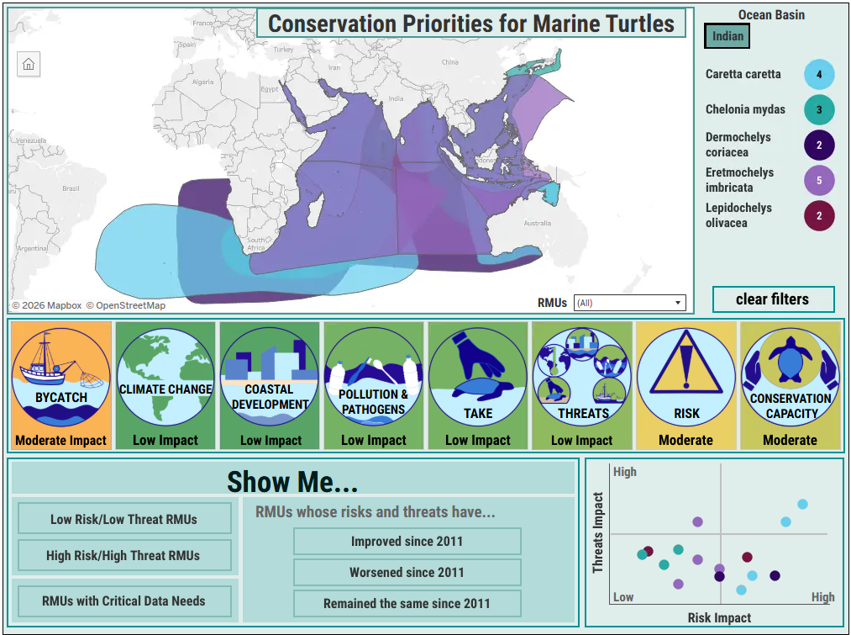
A key partner is the IUCN Species Survival Commission Marine Turtle Specialist Group (MTSG), which brings together marine turtle specialists from around the world to assess population status, identify conservation priorities and develop scientific tools and guidance. One example is the Conservation Priorities Portfolio 2.0 (CPP 2.0), which evaluates marine turtle populations through a set of Regional Management Units (RMUs), these are areas used to assess the population risks, threats and conservation capacity. Its interactive dashboard allows users to explore where populations face the highest pressures, which threats are most relevant and where critical information is still missing.
The CPP 2.0 assessment highlights differences in marine turtle population trends, conservation risks and threats across RMUs relevant to the IOSEA MOU:
In the Western Indian Ocean:
- Population trends: Several green turtle and hawksbill populations show stable trends, while Northwest Indian Ocean loggerheads have experienced declines over both the short and long term. West Indian Ocean olive ridleys also show signs of decline.
- Areas of concern: Northwest Indian Ocean loggerheads remain classified as high risk and high threat, while other populations continue to face conservation challenges.
- Key threats: Fisheries bycatch remains a major concern, alongside coastal development and habitat degradation.
In the East Indian Ocean and South-East Asia:
- Population trends: Northeast Indian Ocean olive ridleys show an increasing short-term trend, while Southeast Asian hawksbills show signs of decline. Other populations, including Southeast Indian Ocean loggerheads and hawksbills, have relatively stable trends.
- Areas of concern: Northeast Indian Ocean loggerheads have fewer than 100 nesting females annually, while insufficient data limit understanding of population trends for Northeast Indian Ocean hawksbills.
- Key threats: Fisheries bycatch remains a major threat, while direct take continues to affect some populations, particularly Southeast Asian hawksbills.
This provides an additional independent scientific resource for Signatories that can help inform regional and national conservation priorities by showing how risks, threats and conservation capacity vary among marine turtle populations.
Scientific cooperation also helps ensure that conservation decisions are built on reliable and comparable information. For example, the MTSG’s Research and Management Techniques for the Conservation of Sea Turtles has, since 1999, provided practical guidance on methods ranging from habitat and population surveys to measuring turtles, monitoring nests and hatching success, tagging, and assessing threats. The manual is among the scientific resources highlighted by the MOU. An update of the manual is currently underway, implemented by the MTSG but kick-started by the request from IOSEA Signatory States to be given reliable guidance. The revised manual will incorporate newer approaches and maintain common standards across the marine turtle community.
The International Sea Turtle Society (ISTS) also plays an important role by creating a global forum for exchanging knowledge and expertise. Its annual International Sea Turtle Symposium brings together researchers, conservation practitioners, students, government officials, and policymakers to share new findings, discuss emerging conservation challenges, build capacity and develop research networks. For many in the constituency of the MOU, such exchanges provide opportunities to remain connected to emerging science, learn from experience across regions and identify areas where further scientific or technical support may be needed. At the same time, guidance developed by CMS or the MOU can be brought to the attention of the practitioners present at these gatherings.
From Turtle Tracks to Conservation Priorities
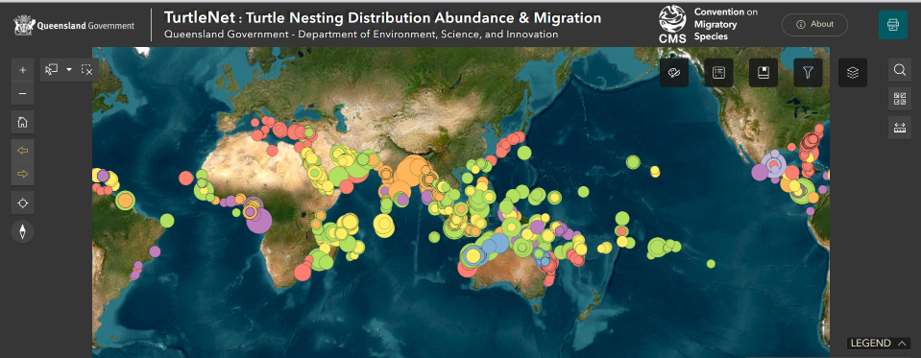
Mapping all important areas for marine turtles including nesting, foraging, mating and migration routes turns many disparate data sets into meaningful information that connects turtles across time and space and supports conservation planning. TurtleNet, an interactive Marine Turtle Breeding and Migration Atlas developed by the Queensland Government in collaboration with the Convention on Migratory Species (CMS), brings together robust scientific information on nesting, feeding areas and migration routes, allowing users to explore marine turtle movements and connectivity across large geographic areas.
Such information is also relevant to the emerging Important Marine Turtle Areas (IMTA) process which are intended to identify sites of particular significance for marine turtles. With endorsement from its Parties (see Resolution 15.4) CMS is a partner to the Blue Corridors for Turtles initiative, which brings together movement and genetic data for all seven marine turtle species to support expert analyses and the future identification and prioritisation of IMTAs.
The collective aim of these initiatives is to provide governments and conservation practitioners stronger scientific evidence to guide habitat protection, marine spatial planning and other area-based conservation measures, particularly where important turtle habitats and movements extend across national boundaries.
By drawing on the expertise of its Advisory Committee and the wider scientific community, the IOSEA MOU helps Signatory States identify conservation priorities, make informed decisions and coordinate action across borders to better protect marine turtles and their habitats.