25,000 Rescues: What One Small Team on a Kenyan Beach Can Do
Somewhere along the reef edge off Watamu, a fisherman feels his net go heavy and wrong. He knows the pull of fish, and this is not that. He hauls it in and finds a green turtle, flippers bound tight in netting and does what fishers here have done for nearly three decades now: he calls the number.
That phone call is the quiet engine behind a number our team at Local Ocean Conservation (LOC) has just watched turn over: 25,000 rescues. It is a milestone we are marking through our own '25 Days for 25,000 Rescues' campaign, but the real story is not the number. It is everything that had to be built, and trusted, for that number to exist.
When LOC started working in Watamu Marine National Park and Reserve in 1997, there was no hotline, no rescue crew, and no reason for a fisherman to believe that calling in a turtle caught in his gear would help him rather than cost him his catch, his time, or his standing with a conservation group he didn't yet know or trust. That trust had to be earned one net, one turtle, one honest conversation at a time.
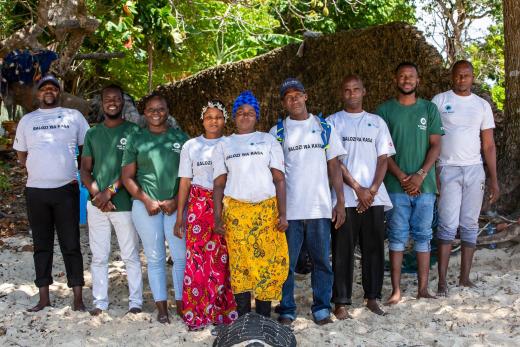
Nearly thirty years on, the hotline runs day and night. Fishers along this stretch of coast, 2,420 individuals, are as much a part of the rescue network as anyone on LOC's own team. When a turtle comes in hurt, entangled, or too weak to dive, it goes to the rehabilitation unit where staff like Lameck nurse it back toward release: cleaning wounds, treating fibropapilloma tumours, weighing and monitoring, and marking the slow, unglamorous progress that ends, if all goes well, with a turtle swimming back out over the reef.
Saro was our 25,000th rescue, named after the fisher who brought her in, a beautiful green turtle who was caught in a net and was missing her back left flipper, she was otherwise healthy and the injury had healed over well so she was treated to a light barnacle removal and then released back into the ocean.
Twenty-five thousand is not one dramatic rescue. It is fishers who no longer see a turtle in their net as a problem to hide but as a call to make. It is a rehabilitation unit that has treated everything from boat strikes to plastic ingestion. It is a community around Watamu that now helps before LOC even asks. None of that existed here in 1997. All of it had to be grown.
The next twenty-five years will ask something different of us. Bycatch remains the single largest threat to turtles in this region, and climate change is already shifting nesting seasons and hatchling sex ratios on our beaches. We are working with fisher communities, local and Indigenous knowledge holders, and partners across the Western Indian Ocean to make protection measures that outlast any one project cycle, because a rescue hotline only works if there are still turtles left to call about.
If we could send one message to the next generation of marine turtle conservationists, it would be this: the milestone that looks impressive from the outside, a big round number, is really just thousands of small, patient acts of trust between people and the sea they share. Build that trust first. Then the rescues follow.
As we celebrate 25 years of the IOSEA Marine Turtle MOU, we showcase some of the people, initiatives and communities that have contributed to marine turtle conservation across the region. Visit our Story Map to discover their stories.