
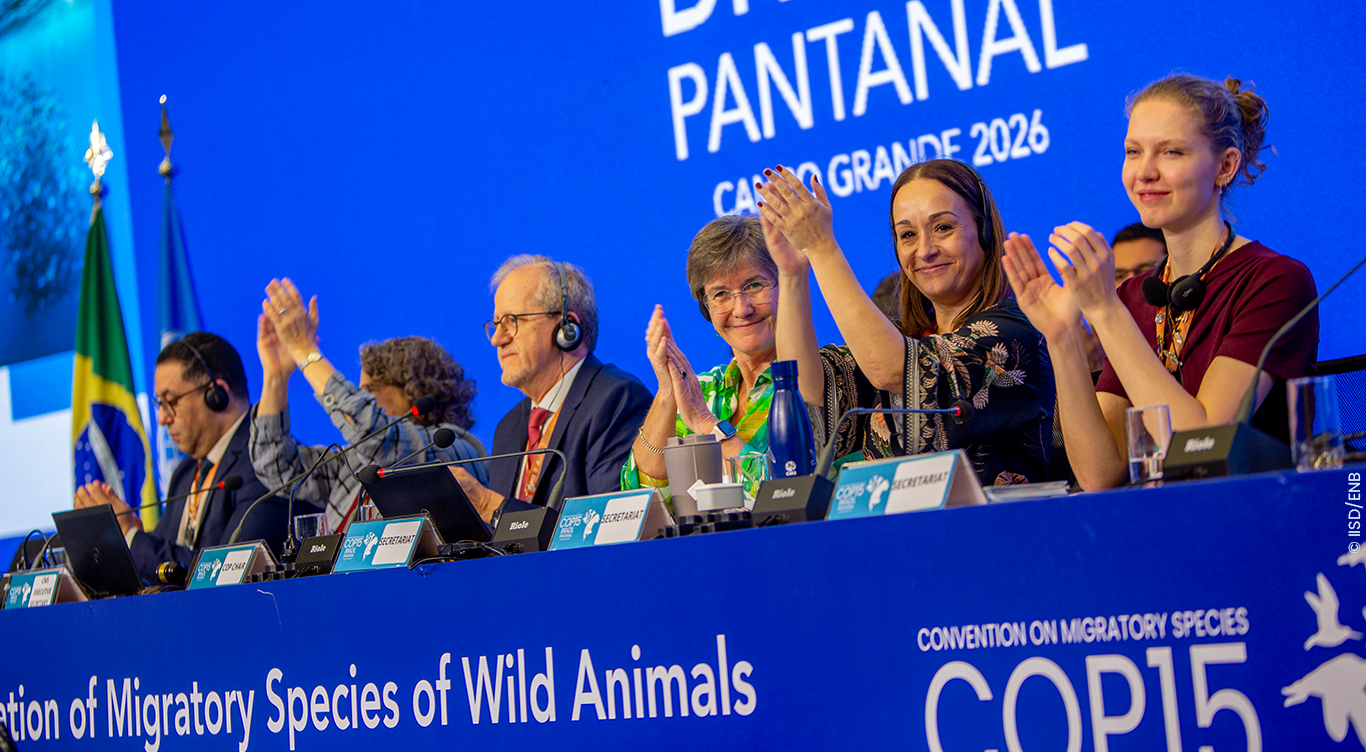
CMS COP15 Strengthens Global Conservation Action for Marine Turtles
Campo Grande, Brazil – Delegates from 105 Parties, 337 observers from NGOs, IGOs, and non‑Party States, and 54 representatives of Indigenous Peoples and local communities came together for the 15th Meeting of the Conference of the Parties to the Convention on the Conservation of Migratory Species of Wild Animals (CMS COP15) from 23-29 March 2026. This COP, themed “Connecting Nature to Sustain All Life”, addressed a wide range of issues relevant to marine turtle conservation. Attention was given to fisheries bycatch, illegal take, and the protection of critical turtle habitats – a reminder of the global challenges and shared responsibility for migratory wildlife.
Tackling the Crisis of Bycatch
Few issues command more urgency than fisheries bycatch, one of the most pressing threats facing marine turtles. Parties reaffirmed their commitment through Resolution 12.22 (Rev.COP15) and Decisions 15.26-15.29, which strengthen international efforts to reduce accidental capture in fishing gear. Most importantly, Parties reaffirmed their obligation to protect migratory species against bycatch by implementing effective mitigation measures, with the goals to (1) prohibit retention of Appendix I-listed species, and (2) for Appendix II-listed species, maintain bycatch at or reduce it to levels that do not threaten their conservation.
To support this, the Review of Technical and Operational Measures to Mitigate Bycatch of Marine Turtles in Commercial Fisheries (Breimann & Baker, 2025) provides an assessment of available bycatch mitigation solutions for various fisheries. These include gear modifications, changes in fishing practices such as reduced soak times or deeper hook setting, and improved handling and release techniques. Pelagic longline fisheries present a specifically high risk for loggerhead and leatherback turtles, but combining large circle hooks with whole fish bait can reduce bycatch by 55-90%. Similarly, trawl fisheries can deploy Turtle Excluder Devices (TEDs) to achieve a bycatch reduction of up to 97%. Some gillnet fisheries have been able to reduce turtle bycatch by over 93% with the use of LEDs that illuminate the nets. Importantly, the use of fish Aggregating Devices (FADs) increases the risk of turtle bycatch in purse sein fisheries and their design should be improved. Overall, governments are urged to adopt proven mitigation tools, expand monitoring, and research new solutions tailored to local fisheries. Additionally, the revised resolution explicitly cites the fish maw trade as a driver of bycatch, highlighting the close link to international trade.
Mapping and Protecting Critical Habitats
The conservation of marine turtle habitats was strengthened as Parties endorsed Important Marine Turtle Areas (IMTAs) as a formal component of the CMS conservation framework. Through Resolution 15.3, Resolution 15.4, and Decisions 15.52-15.56, IMTAs now sit alongside other species-specific tools for the identification of priority areas for conservation, namely Important Marine Mammals Areas (IMMAs, adopted through Resolution 12.13) and Important Shark and Ray Areas (ISRAs, adopted through Resolution 14.7), giving governments the input required to allow effective marine spatial planning to safeguard migratory corridors and habitats. Parties are urged to weave these tools directly into national conservation strategies, a move expected to accelerate protection of high‑value marine turtle habitats across the IOSEA region, including both national waters and the High Seas.
Additionally, the new Decisions 15.98-15.100 on Marine Turtles call on countries to identify, map as well as secure current and potential future nesting beaches, which are essential for protecting marine turtle reproduction in light of climate change and other anthropogenic pressures such as coastal development, dredging and coastal sand mining. The CMS Scientific Council has been requested to develop guidance for this, building on work already undertaken by the Advisory Committee (AC) of the IOSEA Marine Turtle MOU and endorsed by the Signatory States (see here). By jointly addressing these tasks, the AC and the CMS Scientific Council maximize benefits across migratory species groups and will help guide decision-making for the protection of beaches as ecosystems.
Simultaneously, the adoption of a resolution on Conserving Seamount Ecosystems Resolution 15.5) addresses a critical, often-overlooked dimension of pelagic habitat protection. Wholly submerged underwater mountains, or seamounts, serve as biological hotspots and essential navigational landmarks for sea turtles, sharks, and marine mammals. Because these fragile ecosystems concentrate productivity, the new CMS mandate explicitly targets the mitigation of threats from overfishing and destructive practices like bottom trawling.
Alongside habitat preservation, CMS delegates reinforced a strict precautionary stance on deep seabed mineral exploitation (see Resolution 14.6 and Decisions 15.48-49). A report on impacts of deep-sea mining on marine migratory species confirms the profound scientific uncertainty regarding whole-ocean impacts, and the multi-layered threat such activities cause for marine species, including turtles: the intense noise, toxic wastewater, and expansive sediment plumes generated by mining can profoundly disrupt open-ocean navigation, alter prey availability, and permanently damage the benthic and pelagic environments they depend on for survival.
New Decisions for the Action Plan for Hawksbill Turtles
In a set of new decisions relating to the Single Species Action Plan (SSAP) for the Hawksbill Turtle (Eretmochelys imbricata) in South-East Asia and the Western Pacific Ocean Region. Parties reaffirmed the importance of setting up the governance structure to drive implementation. Non‑Party States are also encouraged to join the effort, a crucial step given the species’ vast migratory range.
Addressing Cross‑Cutting Threats
Delegates also confronted broader pressures on marine wildlife that affect marine turtles as well:
Together, Decisions 15.33-15.38renew mandates relevant for the implementation of the work streams on aquatic wild meat, including Resolution 12.15 and the Action Plan for West Africa adopted through Resolution 14.15. The overarching Resolution 11.31 (Rev.COP15) on Illegal and Unsustainable Taking of Migratory Species addresses the persistent threat of over-exploitation of migratory species, including marine turtles
Resolution 15.2 and Decisions 15.42-15.44 target marine pollution, calling for identification of high‑risk regions and close collaboration with bodies established under the BBNJ Agreement. Simultaneously, Decisions 15.45-15.47, relate to the impact of underwater noise on migratory species and available mitigation measures, in line with Resolution 12.14.
A Positive Outcome for Migratory Species
Beyond marine turtles, COP15 agreed to list 40 new species under the CMS Appendices, a great expansion for global protection measures. For marine turtles specifically, the newly adopted Resolutions and Decisions mark a comprehensive addition to the CMS framework.
These outcomes will guide not only the ongoing work under the Convention, but also open many opportunities for close collaboration with the IOSEA Marine Turtle MOU, strengthening coordinated action across the migratory range of marine turtles – from nesting beaches to open‑ocean migration routes.